TL;DR
Two-inch filters reduce blower energy use modestly, but not for the reason most articles claim. Depth lowers the resistance your blower fights at a given MERV rating and holds more dust before that resistance climbs. Field data puts the fan-side difference under 10 kWh a month. The bigger effect is runtime, humidity control, and equipment wear.
Key Takeaways
• Two-inch depth lowers face velocity and holds more dust before resistance climbs. It does not make the system inherently more efficient.
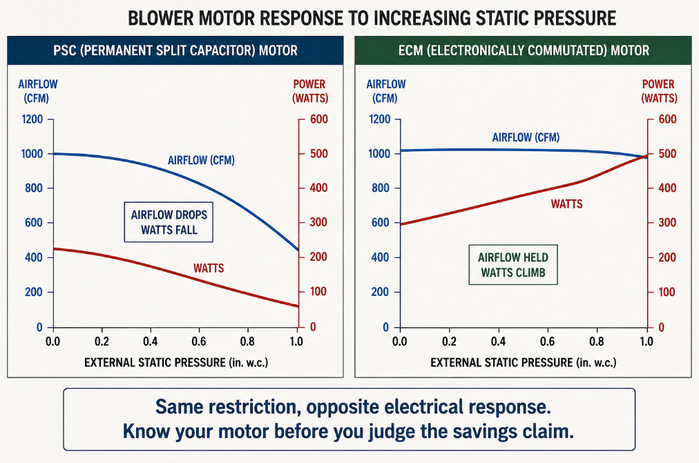
• PSC motors draw less power under restriction while moving less air; ECMs draw more to hold airflow. Motor type decides whether restriction is a bill problem or a comfort problem.
• Field research found under 10 kWh per month separating ECM and PSC fan energy at typical runtimes.
• The 5 to 15 percent DOE figure compares dirty filters to clean ones, not one-inch to two-inch.
• Identify your motor yourself: a run capacitor and fixed RPM mean PSC; no capacitor and a soft start mean ECM.
• A restricted duct system overwhelms any filter benefit. Measure static pressure before spending on filtration.
Do Two-Inch Air Filters Actually Lower Your Electric Bill?
Slightly, and indirectly. Expect no visible change next month.
Your blower is a real load. The Appliance Standards Awareness Project reports that before current efficiency standards, PSC-motor furnace fans used about 1,000 kWh per year, close to 10% of household electricity. That size makes any percentage improvement sound meaningful.
Field research complicates it. A yearlong study of 19 homes in Energy and Buildings found filter pressure drop was not strongly correlated with a filter's efficiency rating, and that fan energy consequences of high-efficiency filters were negligible. With runtimes at a median of 11%, the gap between ECM and PSC fan energy came to less than 10 kWh per month.
What depth controls is how hard the blower works and how long it stays that way.
Your Blower Motor Decides Whether Restriction Costs You Money
Restriction does not raise everyone's bill. The two common motor types respond in opposite directions.
PSC motors hold a constant speed. Under a 150 Pa pressure increase they drew 10 to 23% less power while moving less air. A dirty filter can make a PSC blower draw less electricity. Your bill still rises, but from the compressor running longer with less air across the coil, plus weaker dehumidification and coil freeze risk.
ECM motors hold an airflow target. Under the same pressure increase they drew 46 to 58% more power. Here filter restriction lands directly on your bill, and the heat of fighting a restriction degrades the control module.
“The question we get asked is ‘which filter saves the most energy.’ The question that actually answers it is ‘what kind of motor is behind the filter.’ Until you know that, you cannot know whether a restricted filter is costing you watts or costing you runtime, and those are two different problems with two different fixes.”
This is why a higher MERV rating reduces airflow differently house to house.
How to Tell Whether You Have a PSC or an ECM
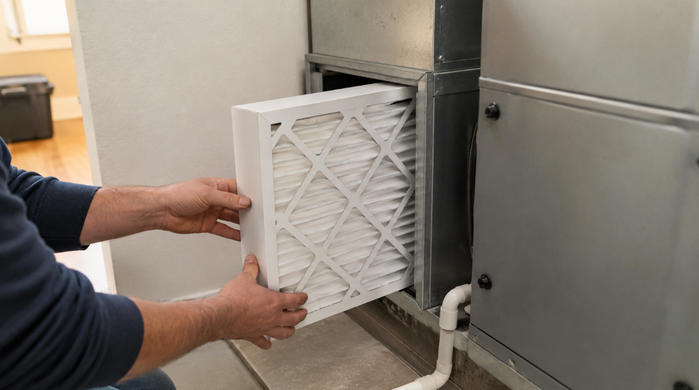
You can identify your motor yourself. Cut power at the breaker and the service switch first. Blower compartments carry line voltage, and ECM modules hold a charge after shutoff.
Work down this list. The first match settles it.
1. Read the motor label. ECMs are marked “ECM,” “electronically commutated,” or “DC motor.” PSC labels list a run capacitor rating in µF and a fixed RPM such as 1075.
2. Look for a run capacitor. A PSC requires one, a small cylindrical can wired to the motor. ECMs have none. This is the most reliable tell.
3. Count the speed wires. PSC motors use multiple colored winding taps. An ECM has a short plug-in connector and no tap selection.
4. Listen at startup. An ECM ramps up gradually. A PSC snaps to full speed instantly, every time.
5. Check equipment age. Higher-efficiency and variable-speed equipment generally uses an ECM. Treat this as a hint, not proof.
If you have a PSC: restriction is stealing comfort and runtime, not watts. Change filters on schedule and fix return airflow first.
If you have an ECM: restriction is on your bill and is cooking the control module. Lower-resistance filtration is a genuine energy decision, and two-inch depth is the cheapest version.
What Two-Inch Depth Actually Changes
Depth does three things.
It lowers face velocity. A two-inch filter fits deeper pleats behind the same opening, typically close to double the media area of a one-inch filter in the same nominal size. Air moves slower through more material and gives up less pressure.
It flattens the loading curve. More media means more dust-holding capacity before resistance climbs. Your blower fights the loaded filter, not the new one, so this is the durable benefit. Compare a new panel against a spent one and the difference is obvious.
It makes a higher MERV affordable in pressure terms. Homeowners feel forced to choose between filtration and airflow only because they are fitting high-efficiency media into a one-inch slot. Two-inch air filters come in the same nominal face dimensions as one-inch, so it is usually a filter swap rather than a duct modification.
Depth does not improve your SEER, reduce compressor load on its own, or deliver a headline percentage off your bill.
Who Should Upgrade, and Who Should Not
Two-inch depth is not a universal upgrade.
Worth doing:
• Your rack already accepts two inches. Filterbuy and others stock two-inch in the same nominal face sizes as one-inch, so the swap is a reorder, not a project.
• You have an ECM and want higher MERV without paying for it in watts.
• Your filter looks loaded well before your change interval ends.
• Someone in the house has asthma or allergies and needs MERV 13 the system can carry.
Not worth doing yet:
• Your static pressure already exceeds the data plate with a clean filter. Fix the ducts; depth will not rescue a starved return.
• You have a one-inch rack and would need duct modification. The energy math does not repay that job.
• You change a one-inch filter every 30 to 60 days with no comfort complaints. You already capture most of the benefit.
• You are buying purely to lower the electric bill. That is the weakest reason on this page, and we would rather you knew before spending.
The “5 to 15 Percent” Statistic Does Not Mean What You Think
That figure is real but misapplied. The U.S. Department of Energy states that keeping the filter clean can lower an AC unit's energy consumption by 5% to 15%.
DOE publishes no methodology behind it: no sample size, no test conditions, no definition of “dirty.” Treat it as directional.
More important: the statistic compares a clogged filter to a clean one, not a one-inch filter to a two-inch filter. Depth means you reach the clogged end of that range later, not that you start somewhere better. ENERGY STAR's guidance still applies: check monthly and change when dirty, at minimum every three months. The same logic governs how a loaded filter degrades a residential AC system.
One thing we found by chasing footnotes: the DOE page most HVAC blogs cite for this figure no longer resolves. The number survives elsewhere on DOE, and we linked a live source above, but much of the industry cites a destination that is gone. Anyone selling two-inch depth on that number is quietly swapping one comparison for another.
How to Measure This on Your Own System
Four readings settle the question for your house.
1. Identify your blower motor type using the checks above. Every number after this reads differently depending on the answer.
2. Take a total external static pressure reading with a manometer at design fan speed, clean filter installed. Compare it to the data plate. Much equipment is rated near 0.50 in. w.c., but the plate on your unit is the only figure that governs.
3. Clamp the blower amp draw at the same time. On an ECM, rising amps mean it is fighting a restriction. On a PSC, falling amps signal the same problem.
4. Repeat both readings before your next filter change. That delta is your actual loading penalty.
If static pressure already exceeds the plate rating with a clean filter, the restriction is in your ductwork or return sizing. No filter fixes that, and ENERGY STAR's maintenance checklist notes airflow problems alone can cut efficiency by up to 15 percent.
Essential Resources for Choosing a Two-Inch Air Filter
1. Filterbuy: Two Inch Air Filters confirms whether your face size is stocked in two-inch depth, with custom sizing for non-standard racks.
2. EPA: Guide to Air Cleaners in the Home covers what MERV to target and how to tell whether your system can carry it.
3. EPA: Air Cleaners, HVAC Filters, and Coronavirus states directly that a two-inch or four-inch filter beats a one-inch, because thicker filters need changing less often.
4. EPA: Residential Air Cleaners, A Technical Summary details ASHRAE 52.2 methodology, MERV bands, and filter resistance.
5. ENERGY STAR: Heat and Cool Efficiently sets the replacement cadence depth is meant to extend, not eliminate.
6. U.S. DOE: Save Money and Stay Cool is the primary source for the 5 to 15 percent figure.
7. Appliance Standards Awareness Project: Furnace Fans sizes what your blower costs to run annually.
Supporting Statistics
Systems Run Less Than 25% of the Time
EPA notes filters clean air only while the system operates, and that residential systems run under 25% of the time during heating and cooling seasons. This is why fan-side savings stay small. Source: U.S. EPA, Guide to Air Cleaners in the Home
Furnace Fans Once Averaged About 1,000 kWh Per Year
Before current federal standards, PSC-motor fans used roughly 1,000 kWh annually, near 10% of household electricity. Filter choice affects a slice of that, not all of it. Source: Appliance Standards Awareness Project, Furnace Fans
Airflow Problems Can Cost 15% of System Efficiency
ENERGY STAR states airflow problems can reduce efficiency by up to 15 percent. The penalty registers as lost efficiency and runtime, not a spike in fan wattage. Source: ENERGY STAR, HVAC Maintenance Checklist
Next Step
Pull your air handler data plate, note the motor type and rated static pressure, then take one amp-draw reading with a clean filter and one before your next change. That comparison beats any filter marketing claim, and costs five minutes.
If your rack can carry more media, confirm your face size is stocked first. Filterbuy lists its two-inch air filters by nominal size and builds custom dimensions for racks outside the standard set.
Citation: Alavy, Li and Siegel, Energy and Buildings. Energy use in residential buildings: Analyses of high-efficiency filters and HVAC fans.
Frequently Asked Questions
Do two-inch air filters save energy?
Modestly and indirectly. They lower resistance at a given MERV rating and stay closer to clean between changes. Fan-side savings are small; the larger benefit is avoiding restriction-driven runtime and equipment strain.
How much energy does a clogged filter waste?
DOE estimates 5 to 15 percent of an air conditioner's consumption, without published methodology. The mechanism is usually longer compressor runtime, not higher fan wattage, especially on PSC systems where restriction actually lowers fan power draw.
Does a thicker filter lower energy cost more than a cleaner one?
No. Changing a loaded filter on schedule beats upgrading depth and stretching the interval. Depth buys a longer window before restriction, not immunity from it.
Will a two-inch filter reduce my cooling costs?
Only insofar as better airflow shortens compressor runtime. If you already measure within your rated static pressure, expect little change.
Does MERV rating affect my electric bill?
Less than assumed. Filter pressure drop was not strongly correlated with efficiency rating, so two filters at the same MERV can differ in resistance depending on media area.
How do i know if i have a psc or ecm blower?
Cut power, then look for a run capacitor. A PSC has one and lists a fixed RPM; an ECM has none and is marked “ECM” or “electronically commutated.” Gradual ramp-up at startup also indicates an ECM.
Can i put a two-inch filter in a one-inch slot?
No. The rack determines depth. Never force a filter that does not seat cleanly, since air bypassing the frame defeats filtration. For odd dimensions, custom sizing from a manufacturer such as Filterbuy beats trimming a stock filter.
Glossary
PSC motor: Fixed-speed blower motor. Under resistance it moves less air and draws less current.
ECM motor: Electronically controlled blower motor set to an airflow or torque target. Under resistance it speeds up and draws more current.
Static pressure: Resistance air meets moving through the duct system, in inches of water column (in. w.c.).
Face velocity: Airflow divided by filter face area. The primary driver of a pleated filter's pressure drop.
Dust-holding capacity: How much particulate a filter holds before pressure drop passes a usable threshold. Scales with media area, and so with depth.
Nominal vs. Actual Size: Nominal is the number printed on the frame and used for ordering. Actual is what it measures, roughly 1.75 inches deep on a two-inch filter.
Learn more about HVAC Care from one of our HVAC solutions branches…
Filterbuy HVAC Solutions - Weston FL
2573 Mayfair Lane Weston FL 33327
(754) 296-3528
https://maps.app.goo.gl/E3tjmKf5VSWYghGc7